
Can Masdeu / Barcelona
Can Masdeu / Barcelona
Camí Sant Llàtzer, 12, Nou Barris, 08035 Barcelona
The access to the property is not far from exit 3 of the Ronda de Dalt / B-20. The camí begins as a junction on the road "Ctra. Alta de les Roquetes", where it is possible to park at the roadside. A chain blocks the way for cars; the 10-minute walk uphill to the Vall de Can Masdeu begins here. It is located in the "Parc Natural de Collserola" nature park, a fantastic hilly landscape with many hiking trails, from which you often have impressive views of Barcelona. Behind the Can Masdeu social, ecological and housing project is located the former Sant Pau hospital, which is cordoned off and guarded by two aggressive dogs. It is now probably only used as a caretaker's "flat" and a warehouse.
Can Masdeu is an old farmhouse from the 17th century, situated on the stream of the same name. The grounds cover a total of 400,000 square metres of woodland.
Can Masdeu has been a squatted space since 2001. Back then, a dozen activists decided to take over the Sant Pau military hospital, which belonged to the hospital of the same name but had been empty for more than fifty years. The aim was to prevent plans to convert the building into luxury flats. In April 2002, more than a hundred police officers attempted to evict the squatters, who resisted non-violently for three days, including chaining themselves to parts of the building.
The owner of the facility, Sant Pau Hospital, finally decided to refrain from any further eviction initiatives. Nevertheless, the possibility of eviction has not been completely banished... Today, around ten permanent members plus guests live there. Both the permanent residents and the guests pay a contribution of 100 euros per month. The rest of the facility's operating costs are covered by organising parties, crowdfunding or organic catering.
From the very beginning, the residents of the building and the surrounding grounds have been committed not only to building an eco-community, but also to creating a social centre and community gardens to foster relationships with the neighbourhood and the rest of the city. The social centre "Punto de Interacción de Collserola" organises weekly workshops in music, arts and crafts, DIY, theatre and dance and hosts gatherings of other social and ecological movements such as Extinction Rebellion or Ecologistes en Acciò, as well as concerts, shows, film and documentary screenings. Around one hundred young people, pensioners and families look after the community gardens, which are divided into 35 plots and grow fruit and vegetables using agroecological methods.
The whole project has five pillars: the eco-community, the community centre, the community gardens, the Regenerades participatory gardens and the Casa dels Futurs (House of the Future). Can Masdeu opens its doors to everyone almost every Sunday. The open days include workshops, talks, demonstrations, concerts and performances, all of which are free and offered by a variety of workshop leaders, activists and artists. And you can buy organic food and homemade products from artisans.
You can support Can Masdeu by helping out, but you can also rent space for your own workshops or concerts.
I found all the activities organised there very impressive. I really like the holistic approach. For example, a lot of emphasis is placed on a feminist attitude, in that "care work", for example, is seen as important work of equal value that is shared by everyone.
https://canmasdeu.net , https://www.facebook.com/people/Can-Masdeu/100007878404840/
41°26'44.0"N 2°09'27.0"E

La Chalmeta / Barcelona
La Chalmeta / Barcelona
Llar Jove - Marina del Prat Vermell SCCL
Micaela Chalmeta 7-9
Ulldecona 24-26-28
Barrio de la Marina del Prat Vermell SCCL
08038 Barcelona
I visited this relatively new cooperative in the Montjuïc district in 2023, bevause a friend of a friend lives there with her family. They have a flat of around 70 m² with two bedrooms, living room, kitchen, 2 bathrooms and a great balcony.
There are various communal areas available for the 67 people (52 adults and 15 children) who live there in 32 residential units: there is a nice large co-working area with eight desks, a laundry room, a communal kitchen and a multifunctional room. If you want, you can create raised vegetables and from the roof of the seven-storey building you have a fantastic view of the surrounding area. There is a shop on the ground floor of the building that sells the products of a farming cooperative (thet is where the picture was taken).
The issue of sustainability is present in many places: the La Chalmeta project was planned using organic building criteria, which means that in addition to ecological sustainability, the vital needs of the people who will live in the building were also taken into account. The strategies are diverse: the spatial design is very flexible and can adapt to the different needs of the users over the course of their lives; synthetic materials are avoided and natural materials such as lime, ceramics or wood are used instead; biocompatible installations are designed to minimise possible pollutants. Residents are offered various training courses on the use and maintenance of the building to teach healthy living habits: how to ventilate, how to save energy depending on the type of light bulbs, tips on the correct use of technology or guidelines for cleaning, etc.
The city of Barcelona provided the land for social housing. La Chalmeta is the result of a competition organised by Barcelona City Council in 2017 for housing cooperatives, which was won by Llar Jove. They then looked for potential tenants. Preference was given to families with children. The neighbourhood is relatively quiet, although a few streets away it's still quite rough. The neighbourhood is well connected to the city centre by public transport.
As is usual in a co-operative, the individual parties had to purchase a share and are therefore co-owners of the property. However, the rent is then much lower than usual in Barcelona. This paid-up share can be inherited, given away or even returned, albeit with a certain time limit. If you are interested in a flat there, you can register on a waiting list.
You can find out how to apply and qualify for being part of the cooperative on their website: https://lachalmeta.coop/persones.php

Vidalia / Puig-reig
Cal Vidal, s/n 08692 Puig-reig (Bcn)
Vidàlia is an ecovillage. It is located in the old industrial mill town of Cal Vidal in the municipality of Puig-reig (Catalonia, Spain).
An ecovillage is a conscious small community that strives for social, environmental and economic sustainability. Its principles are based on respect for nature, the use of renewable energy, food and economic sustainability, recycling and the use of ecological building materials based on bio-construction. There are currently a growing number of ecovillages and conscious communities in Catalonia, for example: La Sequoia, Cal Cases, Irehom, Can Masdeu, Calafou and Mas les vinyes.
We visited Vidalia on 28 July 2024, the day of the "Festa mayor" with a tortilla competition, an exhibition of historical photos, a communal meal, children's entertainment and much more.
The region is called Berguedà. The river El Llobregat (which flows into the sea near Barcelona, El Prat de Llobregat) flows through it. Numerous textile factories were built on its banks, such as Cal Vidal. Cal Vidal is located in the municipality of Puig-Reig and was founded around 1900. Although the industrial revolution began in Barcelona, its development and consolidation mainly took place in the Catalan hinterland. These factories needed water and hydroelectric power and often settled where there had already been former flour mills.
Due to the remoteness and poor transport links of the time, residential and service neighbourhoods were built around the factories, where workers could satisfy all their needs without having to leave the premises. This is where they lived, worked and socialised. In other words, "everything stayed at home". Housing units were built for the people working at Cal Vidal, mostly in the style of terraced houses. In 1905, 200 people were already living there. There was also a church, a school, a kindergarten, a butcher's shop, a fish shop, a hairdresser, a small shop, a theatre, a bar and much more. The Colònia Vidal specialised in the production of high-quality fabrics. There were a total of 15 of these so-called "colònias" in the region. Textile production continued until the 1950s, after which some of the colònias became depopulated and fell into disrepair.
In the case of Cal Vidal, the Vicenc Vidal Foundation took over the site in 1951 and turned it into a diocesan school. Here, young people were offered vocal training, culture, sport and other leisure activities with a Christian perspective. The factory was closed in 1980 when the crisis in the textile industry broke out, and in 1995 the owners decided to set up the museum and open the facilities to the public to show first-hand what life was like in the textile colonies, which played a key role in the industrialisation of Catalan society. To date, more than 250,000 visitors have visited the museum.
Today, 23 adults plus 7 children live on the site. Vidalia was founded in 2017. The legal structure is a housing cooperative and a 75-year contract with the owner company Masoveria Urbana. The residents want the community to continue to grow. Anyone interested in becoming a full member of the community has to go through a process. As a rule, this starts with participation during the various "open days". This is followed by a one-month trial period. After this, both the prospective member and the community make a decision. A longer stay can then begin. The most important questions about this topic are summarised here by the Vidalia community: https://www.vidalia.coop/faq-english/
The general website is: https://www.vidalia.coop/home/
More about the history of the Colònias (as well as photos) can be found on the Spanish-language website: https://www.barcelonaenhorasdeoficina.com/cal-vidal-ultima-colonia-textil-bergueda/
To the museum: https://www.museucoloniavidal.org
The picture was taken in front of the theatre.
Coordinates of Cal Vidal 41°56’39.6″N 1°52’51.2″E – 41.944330, 1.880889.

Ecovila Amat / Vall d’en Bas / Garrotxa
Update, August 2026: The initiator, Didac, wrote on 5th July 2026: "The founder of Ecovila Amat – myself – am currently undertaking a two-month introductory journey through Northern Europe, which you can follow on my personal Facebook page, partly to consider whether or not the Ecovila Amat project should continue in its current form....".
I visited the site two years ago and wrote:
In my opinion, the Ecovila Amat project is only for real adventurers and drop-outs... From the nearest car park, it's a 30-minute walk uphill to the site (if the car park is full, you have to park another 20 minutes further downhill on foot). However, the caretaker, Dídac, can drive his jeep up the bumpy track to carry luggage and materials.
The path leads through shady forest along the course of a river. There are always opportunities to take a dip in the pools.
Camps for youth groups, for example, are organised at the Ecovila Amat site. They camp there. There is a house with a double room, a lounge, wood-burning stove, kitchen, showers and toilets. There are also some permanent residents who live in tents on the large, hilly site in the forest. Most of the spacious tents are built on a platform and are designed for longer stays. The view is always spectacular; mostly of the surrounding mountains, sometimes even of a waterfall high above.
Since 2023, you can register and help with building projects or with the animals. You will find a summary on their own website:
Summary in English
The Ecovillage Amat is a new proposal of cooperative housing and work, in la Garrotxa, a region of the Pre Pirinees in Catalonia. A vulcanic region with hundreds of hectares of preserved and comunal forests, and lot of history, at 1h30 from Barcelona. Where the first worker union was created in 1440, el Sindicat Remença, and where that peasants struggle led to the end of feudalism in Catalunya in 1480. -1 century before England and 3 centuries before France.
The Ecovillage will try to offer 5 to 10 living spaces for permanent inhabitants, and other spaces for visitors and friends. We will also try to create work cooperatives in agroflorestry, permaculture, free education, wood work, artistic and eco-academic events and ecologic hostelling, in order to be fully sustainable in the economic level, both individually and collectively.
Our economy combines, as in the Catalan EcoNetworks (EcoXarxes) and Catalan Integral Cooperative, 5 economic spaces: comunitarian economy; barter economy; local currency, FairCoin -p2p criptocurrency-, and Euros economy, in cooperativism and fair trade ways. Everybody is welcome to join and share some days or weeks with us, contributing with work, ideas, art, local currency or regular money.
The land, with 70 hectares, was bought in 2015. The quotes of those willing to live permanently in the Ecovillage, will allow the process of full collectivization of the land to take place. And will offer the Ecovillage the economic means for rebuilding the old houses. At that time (Winter 2019) we just finished rebuilding the first house, with 2 rooms.
The project is inspired by eco libertarian ideas, hippism, indigenism, ecumenism and pacifism. Tolstoy, Dylan, Lennon, Gandhi… We work with assemblee and consensus, and with work and housing cooperative in a legal level.
you can write us at ecovilamat@riseup.net
and find us in facebook here:
https://www.facebook.com/groups/1076884172325635/?fref=ts
Becoming part of the Ecovillage and visiting us
To become a permanent inhabitant of the Ecovillage, a co-owner of the land and have the right of use of a personal, familiar or group appartment, families have to satisfy a Cooperative Share with monthly quotes. This amount is calculated dividing the total cost of the project by the families that will be able to host as permanent inhabitants.
The ownership of the 70 ha of land begins as a private property with the desire of becoming a collectivized ownership through a Housing Cooperative, that will own the land and houses when the permanent inhabitants complete their share of the cost of buying the land and rebuilding.
In addition, temporal inhabitants can share appartments for a fraction of that cost, work and weight in the decisions.
And all visitors and friends are welcome, and can pay their stay with work, local currencies and euros at affordable prices and free share of all the knowledge created in the ecovillage.
Come and visit us, the place is a paradise! at 1h30 from Barcelona up pyrinees!
Contact us at ecovilamat@riseup.net

Convent de Pontós
In the middle of the small town of Pontós lies a former monastery, which is now inhabited by a colourful mix of people. The majority are artists of various ages, and many children also live here. To get an idea of the grounds and the great atmosphere, the cultural events that take place there from time to time are particularly worthwhile. I was there for a poetry festival in 2023 and for the "Teatre Humor, Creps i Pensament critic" on 4 May 2024 (the photo is taken from this event).
The interlocking buildings form a boundary to the town on the outside. Inside, there is a beautiful square from which you can access a garden area, a semi-derelict atrium and other buildings. There is also a bar open during events where you can get drinks.
From their own website: MUTTE CULTURAL is an association that is directly linked to its place of activity: the monastery of Pontós. An inspiring place between nature and village life, between the Pyrenees and the Costa Brava, full of history and the passage of time.
The property, which was originally just a 16th century farmhouse, was extended in 1900 to become a Marist seminary and then converted into a colony house. To this day, it has housed generations of Pontos, people from Emporda and people from everywhere within its walls. They have also recently opened to the public one of the most avant-garde festivals in Catalonia (the Mapa), which still leaves its mark on its landscape today
Open on the first weekends of the month and on other special dates from April to November. Closed December, January and February. If you would like to receive information via Whatsapp, you can add the following contact and write to them to subscribe to the mailing list
+34 (0) 623 99 06 81
Informantion for the Events:
https://www.instagram.com/mutte_cultural/?hl=de
Tamera / Portugal

I visited Tamera in September 2020. I had been dreaming about it for a long time. Because what I had heard about Tamera inspired me: a place where more than 100 people of different generations and countries live together, where seminars are organised, a community that is almost self-sufficient and a place for peace and love development.
What particularly impressed me during my visit was the history of today's lake. When the community arrived there, there was hardly any water. An Austrian water engineer advised the community and so they created a lake in a suitable place in the otherwise quite dry area, which is now the water supply. It is also very impressive that the canteen kitchen for the seminars is run entirely on alternative energies. The toilet facilities are organic composting plants and the waste water is treated in their own wetlands.
They describe themselves as follows: “The project, which began … with a small group, has now developed into a community of around 160 people and a growing international network.”. Together they are working to build decentralised and independent models for a post-capitalist society.
Their vision is: “We believe in the possibility of a future without war and love without jealousy. We work for the realisation of a vision, Terra Nova, in which we build healing biotopes as research centres and models for a new planetary culture based on a strong ethical foundation.”
This year, Tamera is celebrating its 30th anniversary. Today there are:
• Various types of accommodation for the permanent community members of Tamera: houses, cabins, yurts, mobile homes, etc.
• The Tent Hall – 4 seminar rooms and dormitories for sleeping
• Guest welcome center
• Campus kitchen
• Guest House
• Pilgrim huts
• Health clinic
• Herbal house
• Swimming lake
• a textile workshop with recycling and creative upcycling of clothing and fabrics.
They have around 330 acres of land, with many buildings, gardens, roads, a children’s school and an education campus. The Aula is the largest straw bale building on the Iberian Peninsula and the focal point for community gatherings and our Sunday matinees. 20kW photovoltaic plant directly supplies Tamera with power, and the surplus is harvested and stored.
How can you know Tamera / take part in the community?
The guest season usually runs from mid-April to mid-November. You can take part in introductory weeks or in-depth courses or do an internship. You can also attend an event. The calendar of events can be found here...
https://www.tamera.org/event-calendar/
Although I had decided at the time that it wasn't the right place for me to live: I am very connected to Tamera, e.g. I am part of the new peace project ‘Women in White’. The movement, which was jointly initiated by Aida Al-Shibli (Tamera) and Miki Kashtan (NGL), stands for the unconditional search for non-violent solutions: “End war - live peace. No tolerance towards any form of violence.” One focus: to advocate an immediate end to all violence in Israel and Palestine and to campaign against the oppression and atrocities that people are experiencing today. Here is a quote from the statement from Sabine Lichtenfels, one of Tameras founders: ‘We are in the process of awakening from our unconscious collective traumatic film of several thousand years of war history, a horror film that currently dominates war events on this earth and leads to ever greater human catastrophes. If we saw with an open heart what is happening right now in Gaza and Israel, we would instantly forget all our habits if we knew how to end the war. We are ready to change our own lives to find a way to help. As long as we humans believe that we can end wars by killing our enemies, all wars will continue.’
Can Traver / Besalú

Can Traver is the largest farmhouse in the area around Besalú. The entire complex has been renovated in a very authentic way. There are spacious interiors, dining rooms and rooms with bathrooms, as well as outdoor spaces with swimming pool, terrace, vegetable garden, forest, countryside, orchard. There is even a small chapel.
It is not a community, as they are actually presented here in this blog, but the ensemble is run by a family. However, there are always events organised here where you can meet like-minded people.
It is a spiritual place, so the events are for example: Yoga, dance or meditation retreats, forest bathing, seminars on femininity, cookery classes, painting or writing courses. I was at Can Traver as part of a Naad Yoga event.
The beautiful complex can accommodate up to 60 people. The rooms are simple, comfortable and cosy, with single beds, mostly in shared rooms.
Also available for individual stays. More information :
Escapada rural / Osor / La Selva
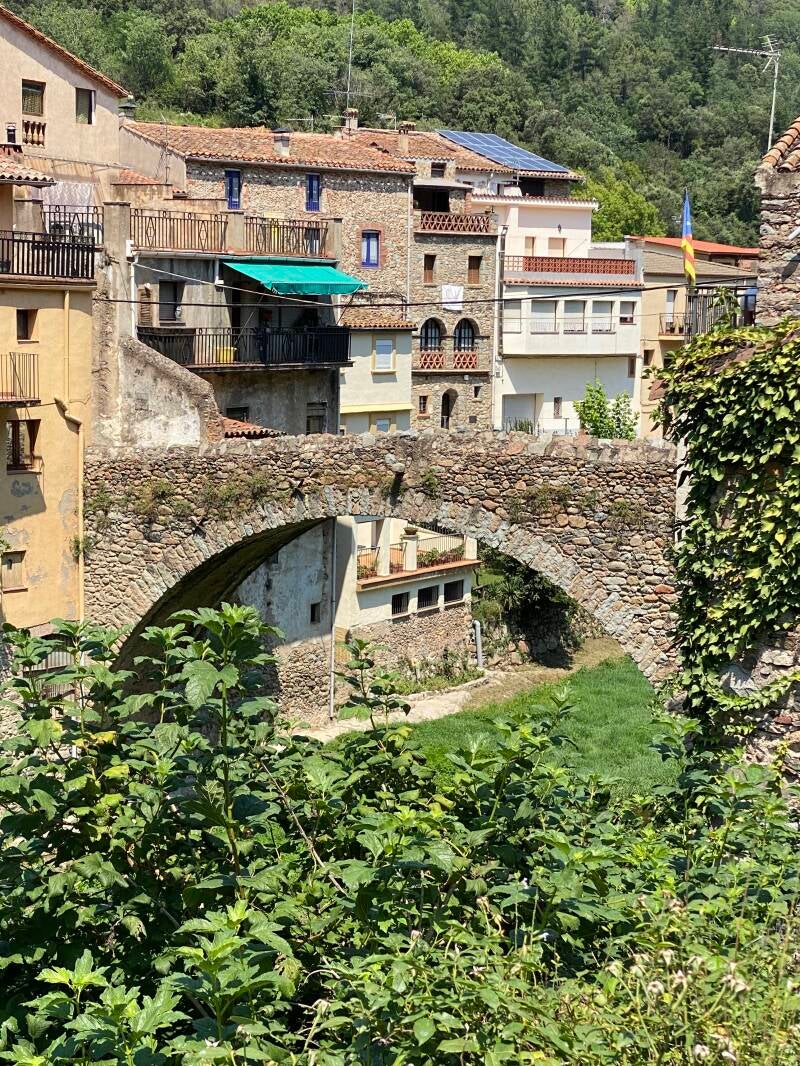
Update, August 2026: it seems that this small community and the hotel no longer exist...
I went to the Escapada rural with a friend in July 2024. The building is a former convent run by Kirsten, who fulfilled a dream by buying the building a few years ago. Kirsten grew up in Catalonia, as a daughter of a German mother, and speaks French, Spanish, English, German and Catalan.
In addition to Kirsten and her son, a family of three live there permanently, another family on a long-term basis. The other rooms have so far been rented out for vacational purposes. In the long term, Kirsten would like to have even more community living in the beautiful building.
The Escapada rural offers overnight accommodation with a terrace and barbecue facilities. There are shared bathrooms. The shared kitchen is equipped with a fridge, oven, microwave, hob, toaster and coffee machine.
The village of Osor has around 400 inhabitants. There are two restaurants, several accommodation options, a bakery, a small shop, a swimming pool and the obligatory church and town hall. If you want to explore the area, there are great opportunities for cycling and hiking in the neighbourhood. Kirsten also offers private yoga and cookery classes.
We felt very comfortable. You usually meet the other residents of the accommodation for breakfast and dinner....
More information: https://www.bedandbreakfast.eu/de/a/rbNg48wGffuh/escapada-rural-yoga-piscina-cerca-descanso

Ecovillage Pourgues / South-France
Update, August 2026: Unfortunately, the project no longer exists in this form; shortly after our visit in 2025, the community appears to have disbanded. The project is now continuing under a different name; the old website redirects visitors to the new one. It’s a real shame, because this particular project had really impressed us.
In February 2025, a friend of mine and me visited the Écovillage de Pourgues, a community founded in 2015 in Le Fossat (Ariège) that follows the principles of permaculture and democratic education. With 35 inhabitants, it is guided by values such as freedom, ecology and democracy. Members are actively involved in shared projects and the onboarding process includes meetings, immersion and a trial period. As well as being the largest ecovillage community in France, they also offer accommodation and workshops to learn more about ‘democratic schooling’ and effective communication. The model of conflict resolution through creative circles and collective decision making is an example of how more co-operative and peaceful communities can work. We found them through the GEN Europe Global Ecovillage Network.
You can book a holiday stay (in the summer season), workshops or (as we did) a tour via their website https://www.ecovillagedepourgues.coop . This costs ten euros per person for a minimum of three people... in our case, Yohan, one of the founders of the Ecovillage, showed us around. He told us a lot about the different forms of communication that they have tried out and those that they have now established in order to reach sustainable decisions in their community.
The whole project came about through people who joined the so-called ‘democratic schools education movement’, of which Yohan was one. This began more than a century ago in the United Kingdom with the founding of Summerhill School by Alexander Sutherland Neill in 1921 and is based on a simple principle: children are seen as independent individuals who are free to decide their own path in life. They are responsible for their daily decisions, for what they do with their time and what they learn.
Parents have full confidence in these decisions and in the mechanisms inherent in the nature of the young child to learn and adapt to their environment. Everywhere in the world and since the beginning of time, children play freely and socialise with people of all ages, integrating themselves into the functioning of their collective and living in the midst of ‘real life’.
Through this exchange and a common idea, various people came together who had the dream of an ecovillage. In May 2016, around twenty people came together to create the first ‘democratic village’ in a voluntary process of social change. When searching for the physical location, the first property the group looked at was Pourgues, and it was love at first sight. The property was purchased through a community effort. From 2017 and 2018, they lived and worked here together. You can read more about the rest of the story and the challenges here: https://www.ecovillagedepourgues.coop/blog-pourgues-2025/26/2/2025/4h984m1ek9vyn6709lhyn0x059a5s5#
The values of the community can be found on the website, as well as the opportunities to become part of it. As a rule, you take part in a one-week stay, fill out a questionnaire and then (after a positive vote by the decision-making committee) take part in a one-month stay, where you take part in meetings and work assignments. After that, a committee decides again and after an enthusiastic ‘yes’, the one-year trial residency begins... https://www.ecovillagedepourgues.coop/rejoindre-le-projet#
In order to finally become part of the community, the financial obligations are as follows:
Financial commitments
- Initial capital contribution: Between €30,000 and €60,000 per household (single person, couple or family), recoverable in the event of departure.
- Monthly contribution: Between €500 and €900 per adult to cover expenses (accommodation, food, work, etc.).
People live in the main house (which you can see in the photo) and in various other forms of housing, such as tiny houses, caravans or dome houses.
We were really impressed by everything: the location, the open manner in which Yohan answered all our questions, the different ways of living there and the exciting communication tools that were found to reach compromises.
L’écovillage de Sainte Camelle / Ariège
The Sainte Camelle Eco-Village
When we arrived, the surroundings were completely silent and empty — which surprised us. After calling our contact person, a very friendly man arrived quickly to show us the way and explain the basics. It was already late and we were tired, so we left the rest of the exploration for the next day, which we did on our own.
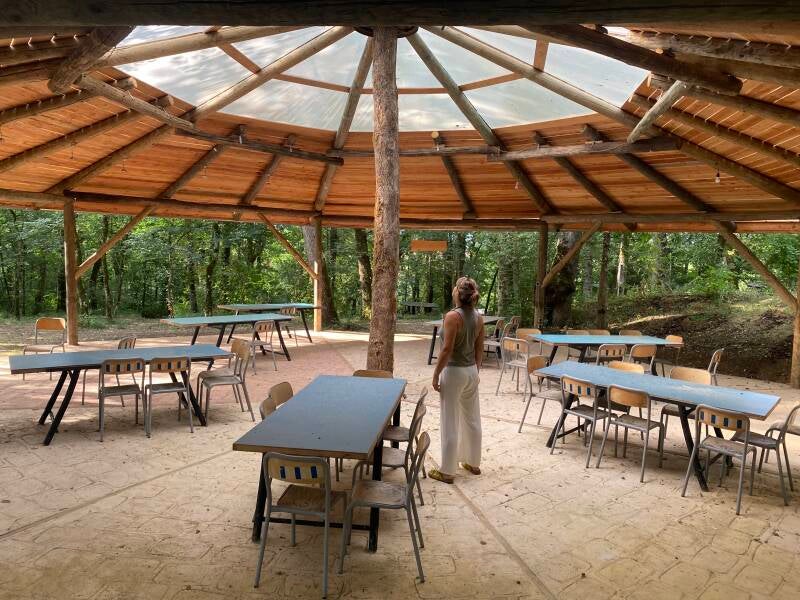
We stayed in the „dome“. This structure, made of wood and straw, has a transparent roof that allows us to see the moon and stars under the tree canopy. Both this space and the treehouses had a community kitchen at ones disposal, located in the middle of the forest. The kitchen was made of wood, open, and fully equipped with everything needed to cook, including gas, running water, fridge, pots, plates, and more. The showers were also an immersive experience in the forest, with hot and cold running water.
The Sainte Camelle Eco-Village was founded in 2011 and is located in Ariège, on a 18-hectare plot of land (including 11 hectares of forest), in the municipality of Saint Victor Rouzaud, near Pamiers (50 minutes from Toulouse). The community currently has a maximum of 20 residents who live together in a communal setting with independent living spaces, business activities, and shared services. Their vision is based on love in action and inner ecology to manifest their deepest aspirations.
Community Principles:The relational harmony is the foundation on which the community is built. Residents share this vision through the 7 essential principles for living in a community. They have a sustainable economic model based on collective activities that allow them to share their daily life and interpersonal skills, such as ecotourism, workshops, immersions, events, and personal projects.
Ecological and Social Commitment: The eco-village is committed to transition and sustainable living through various experiments:
- 100% organic and vegetarian food
- No consumption of alcohol or drugs
- Ecological constructions
- Water management
- Climate adaptation
- Resource center planning
Community Café: The La Luciole community café contributes to the life of the eco-village and the region by creating events with the neighborhood, stimulating solidarity, and offering cultural, recreational, and artistic events, as well as organic and vegetarian catering services. Status from 29th July 2025: “The cafe is currently on hiatus. We'll keep you informed of a resumption date!”.
Infrastructure: Piped water and electricity supply all structures.
Accommodations
- Treehouses: Two treehouses are nestled in the forest, each with a sink and running water. Capacity is 2 adults , 1 kid.
- Dome: A very wild and unique construction, the dome features a comfortable double bed and a transparent roof that allows you to see the stars. It's a truly magical experience.
- Mandarina House and Ciruela House: Two cozy rental houses.
- Main House: A communal living space with a private area for residents and a public area featuring a living room, foosball table, library, and bar.
- Campsite: A circular area with its own bathrooms and showers.
Community Spaces:
- Community Kitchen: A fully equipped kitchen in the heart of the forest, under an open wooden structure, with a gas stove, fridge, pots, pans, and a large table for communal dining.
- Bathrooms: Shared bathroom area with hot showers and compost toilets.
- Hexagonal Spaces: Two large, wall-less spaces made of wood, perfect for classes and workshops. Each has a contiguous kitchen and dining room.
- Fairy Trail: A charming path through the forest, decorated with sculptures and messages, featuring meditation spaces.
No Pets Allowed
No new animal friends are accepted in this place.
We left with a warm impression, moved by the magic of this woodland space. It sparked in us a desire to return — to connect more deeply with the team, to learn from their experience, and to explore the talents of the founders.
https://ecovillagestecamelle.fr
Collectif Montgrenier / Aude
Shortly before arriving at the Collectif Mongrenier, we took a break in the beautiful countryside that surrounds the estate. We got to know the nearest neighbour of the community, a gentleman in his 80s, who wanted to know what the van outside his property was all about. In the course of the conversation (in a mixture of French, English and Spanish), we agreed to meet at the party, which was to take place that evening at the Collectif Mongrenier.
Upon arriving in Mongrenier, we were struck by the peaceful atmosphere. Bettina escorted us to the cabin La Forge that would be our accommodation.
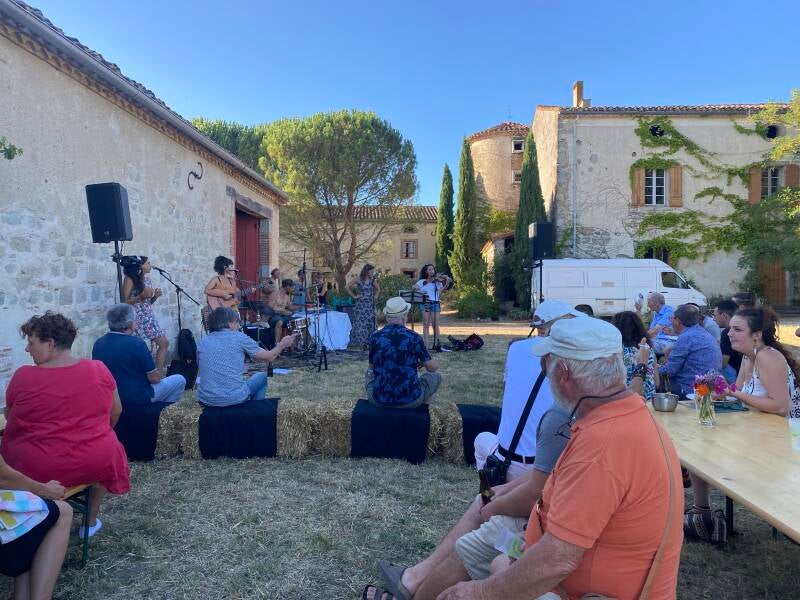
That same afternoon, we connected with the spirit of the place in a deeper way. We were invited to a garden party next to the carefully restored old barn: a multipurpose space with a stage, bar, sofas, tables, a children's corner, and a small shop selling preserves made with garden produce, run by a full-time dedicated staff member. The concert—open-air, biergarten-style, with views of the Pyrenees—was given by two members celebrating ten years of life together. An open-to-the-public event that brought together around fifty people from neighboring villages in a warm and festive atmosphere, filled with multicultural music and good conversation.
About the project
Collectif Mongrenier is located in the heart of nature, just half an hour from Carcassonne. The site has four stone houses that can accommodate up to 35 people, surrounded by 85 hectares of fields and forests. Currently, 11 people live there permanently, and the collective is open to new members.
With the withdrawal of some founding members, the possibility of acquiring shares in the company that owns the site (SCI) has been opened, valued at €40,000, allowing one to become a part of the project's co-management. It is also possible to join the operating association (ACM) without an initial investment: in this case, after a period of cohabitation, continuity is considered. The annual fee is €50, and the monthly cost of living is €800, including accommodation, utilities, basic food, and use of the common facilities.
From their website: “Collectif Mongrenier is an intergenerational, multinational co-living project whose values are deeply rooted in our connection to nature. We are a working farm with sheep, ducks, fruit and nut trees and a permaculture garden which provides most of our fruit and vegetables. Visit Mongrenier to experience guest accommodation with something for everyone, from back-to-basics camping to our artisanal farmhouse.
We look forward to sharing our corner of paradise with you!”
Workation + Digital Nomads
Mongrenier is also the perfect place for a workation and for digital nomads looking for a longer stay. We have three rooms available in our smaller co-living, co-working house, with prices based on how long you would like to stay. The shared living spaces offer the chance to connect with other guests and members of our community and the views offer inspiration to motivate you with your work.
Stays up to 14 nights cost 40 Euros a night
Stays of 14-30 nights cost 35 Euros a night
Stays longer than a month cost 30 Euros a night
Prices include Wifi, bills, bedding and towels
Transport and food can also be provided at additional cost.
https://www.visitmongrenier.com
Sieben Linden / Germany
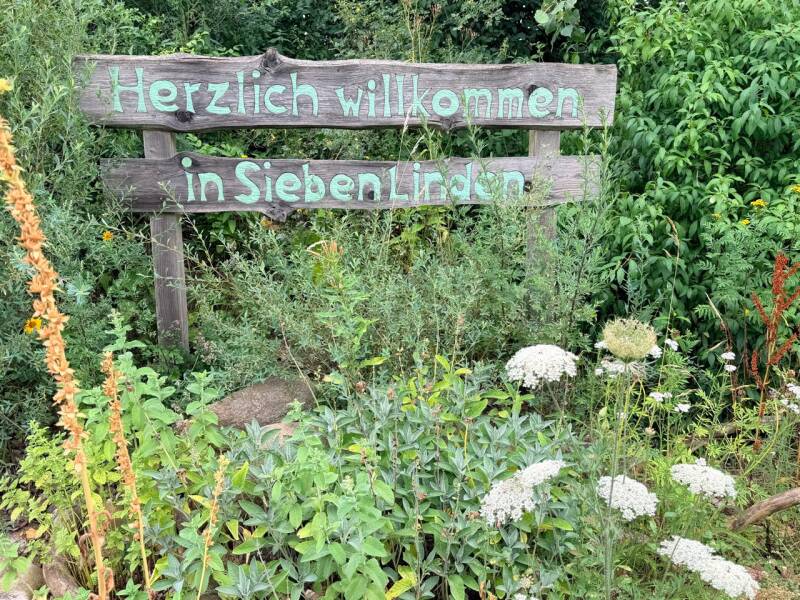
Upon arrival, just by seeing the number of bicycles and vehicles at the entrance, you can already sense that it is a proper village. One of its members welcomes us, and I am surprised that they start with a topic as down-to-earth as the toilets: "All our bathrooms are dry composting toilets that do not use water, but they have a ventilation system that prevents bad odors, so please do not throw anything down them other than the toilet paper we provide here, and use the hygiene products we use in the village".
They make it clear right from the start that soaps and paper must be chemical-free; if you use your own, it is only allowed if it also meets this rule. Another crucial detail —and this is the first ecovillage where I've heard of it— is that mobile phones are not allowed in common areas: it is a village free of Wi-Fi and electromagnetic waves. So if you need to make a call, they ask you to walk out to the bus area and connect there. A solid and seamless declaration of principles: 100% ecology, both the kind you see and the kind you don't. ;)
They show us the bungalow area and the Wohnwagen, old railway carriages covered in wood and adapted as Tiny Houses. This is the most affordable option for living in Sieben Linden, costing around 100 euros a month. Some residents share houses, while others live more independently in these Tiny Houses.
The place is wonderful, starting with the construction. They count on eleven residential buildings built with straw bales, including the first three-story straw-bale building in Europe, a true pioneering benchmark. The buildings look solid and entirely coherent with their surroundings. We reach the central village square, where a small café, the main seminar building, and the organic shop converge. Behind it, in another square, there is a bar, a carpentry workshop, and on the other side of the square... a recently built straw hotel where most of the people who come to participate in seminars, courses, or camps stay. It looks very new and modern, hosting more than 10,000 overnight stays a year.
The square in front of the hotel is filled with Biergarten-style tables and is buzzing with family life because we coincide with a Family camp! What a great idea; while eating, I happen to share a table with a mother and her 9-year-old daughter. This happens a lot in these kinds of structures in Germany: sharing a table and space, while conversation happens naturally and voluntarily depending on the circumstances. Chatting with her, she tells me it is her second year coming back and that she really likes it because it's a very pleasant place that offers a high-quality program for both children and parents.
At lunchtime, we enjoy a delicious buffet option outdoors in this central square, just like I mentioned.
In the afternoon, a veteran member of the village welcomes us and explains that a geomancer told them there were three energy spots in this village, connected by what is called a Dragon Line. We go to visit these three spaces:
An ancient tree with a spectacular shape, unlike anything I had ever seen.
A small lake with a tiny beach, a place of great peace.
A space to remember ancestors, featuring a place to sit and large stones with the names of people who lived in Sieben Linden and are no longer here, or the names of deceased family members of Sieben Linden residents.
This space touches me especially. We did a small meditation together to remember our ancestors, and it was emotional to realize how little time I am spending remembering my dear uncle, who passed away in December... Thank you, Sieben Linden, for this space and this moment.
Then, walking through the village, we discover many other spots with very special care and magic: the Silence House, made for meditation. They told us it was controversial because not everyone wanted to contribute to the cost of this space, and in the end, it was funded by those who were actually interested in it. Then we saw a yurt equipped with a circular bench all around its perimeter and many blankets... tribal images immediately came to mind, tribal meetings. Another place with a magical touch was the surrounding vegetation tunnel, and another space with a bench and natural sculptures made of naturally weathered wood.
We also visit the impressive vegetable garden, which grants them an autosufficiency of nearly 80% of all the food consumed by the residents and seminar participants. Beyond traditional gardening, Sieben Linden stands out for its agroforestry projects: they integrate rows of trees and shrubs among the crops to positively modify the microclimate, prevent erosion, sequester CO2, and promote biodiversity and humus formation. In larger fields, such as the Nordacker area, they have removed entire strips from conventional agricultural production to plant strips of fruit trees (apple, plum, pear, and walnut trees) alongside species like willows, rowans, and poplars, achieving a perfect balance where agricultural machinery and nature work hand in hand.
Many activities are organized in Sieben Linden, as they explain to us: men's circles, women's circles, social circles... Friday cinema, parties at the bar... This woman tells us that so many things happen that you have to learn to self-regulate because you can easily get involved in so much work that you might suffer burnout. We also heard this at ZEGG; I imagine it is a common theme in such active ecovillages. And on the other hand, she explains that they have tools to continuously evaluate how everyone in the group is doing. For example, in meetings, everyone always starts by saying two sentences about how they are feeling at that moment so they can calibrate and see where each person stands.
https://siebenlinden.org
From this website: "The Sieben Linden project started in 1989 when several people came together to discuss the idea of a self-sufficient, ecological village. In 1993, they bought a project centre in a village called Groß Chüden.
In 1997, the group bought the actual site of Sieben Linden and part of the people living in Groß Chüden moved to Sieben Linden few months later. The existing old farm has first been renovated following ecological methods and converted to the community building, then becoming the main place of community life and seminar centre.
Since 1999, several infrastructure elements have been established: a parking, paths, electricity and telephone lines, wells, plant drainage system, ponds, amphitheatre, hedges for windbreaks.
The ecovillage site has grown to more than 100 hectares, including:
6 hectares of building land on which the community has built 11 residential buildings shared by different families, several community centres and other buildings for the community (meditation house, wood workshop, stables,…). Dozens of trailers are also installed, where community members live.
over 70 hectares forests
8 hectares gardens/pasture
20 hectares arable fields, which are currently rented to a local farmer, which cultivates them ecologically
The community has now around 150 inhabitants and aims at reaching 300 inhabitants: there is no rush for them to reach that population, the most important is to enable a progressive and organic growth of the community.
The ecovillage is situated in the federal state of Saxony-Anhalt: this state, which was part of East Germany, has experienced a continuous reduction of its population since German reunification. Sieben Linden, which conversely attracts more and more people, arouses the interest of the politicians who deal with the demographic challenge.
Contact with the region has also intensified over the years. The visits and continuous reporting in local newspapers regularly invite the neighbors to Sieben Linden. Sieben Linden is a well integrated part of the municipality of Beetzendorf. A project member is there in the municipality council.
Visits
We would like to welcome our guests with our full attention and on the same time focus on the construction of the village. Therefore, we ask you to visit us only by prior registration. Our exception is the Sunday café, where a registration is not necessary and you can enjoy cakes and a free ecovillage guided tour (most often in German language).
Inclusion process
Before having the possibility to move in the community, new members are asked to follow an inclusion process: this process is the opportunity to confirm that there is mutual interest and sympathy between new members and the community. It is also a way for the community to ensure that new members have performed the introspection necessary to be sure that they really want and can live collectively.
After a first visit (through the summer camp or a workshop for example), the candidate have to follow several workshops which present the community and its functioning (more particularly the decision-making process).
After these workshops, a 1 year trial period can be proposed to the candidate: the candidate will be officially introduced to the community and 2 tutors will be named to support the candidate during all the trial period, to find a place to live for the new member and define an activity enabling the candidate to provide for his needs.
After the trial period, the community will vote to decide if the candidate can be accepted in the community.“
Adress:
Ecovillage Sieben Linden
D-38489 Beetzendorf OT Poppau (for some navigation devices Bandau OT Poppau)
Tel. 039000-51235
Fax: -51232
Email: info (@) siebenlinden.org
Core office hours: Mon – Fri: 09:30 – 12: 00h
Schloss Tonndorf / Germany
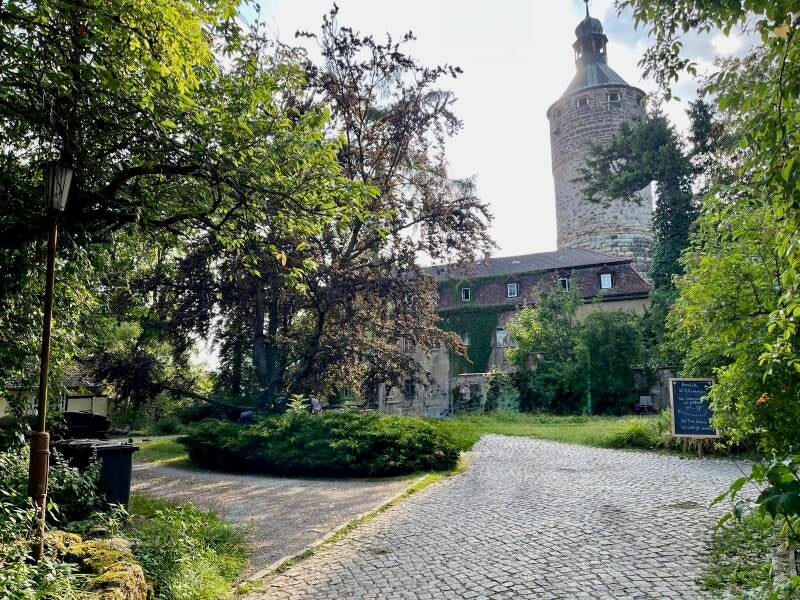
Schloss Tonndorf is a castle and fortress that can be seen from the village of Tonndorf itself, as it stands atop a hill. I find it fascinating and am struck by the very idea of an ecovillage living in a castle!
Upon reaching the entrance to this palace-fortress, I was even more awestruck. It is incredibly beautiful. The castle, with its imposing stone tower some 40 metres high, is surrounded by a moat which is currently dry but overgrown with wild vegetation. I was immediately struck by fantastic images of times gone by, like something out of a film featuring knights and ladies. Germany has these surprises: palaces, castles, factories or spas may have been converted into interesting social and cultural projects.
We were welcomed by Peter, a member of the community, with great warmth and kindness, and he explained several fascinating historical details to us, including the curious anecdote that such prominent historical figures as Napoleon and Goethe once stayed here.
Walking around here makes you feel the weight of history. It’s incredible to think that this place began life as a medieval fortress in the 10th century to protect the salt route, survived looting during the Peasants’ War of 1525, and was reborn as a Renaissance palace. After housing a school and a care home in the 20th century, it lay abandoned until it was restored in 2005.
We had our meals in the multi-purpose room at the castle café, a modern and cosy space with stunning views over the village and the surrounding hills. I say ‘multi-purpose’ because it has a kitchenette, which we later used to prepare our own dinner. The café is run collectively and cooperatively by the residents themselves, and is open to the general public to connect the project with people from outside the community. Both the café and all the renovated parts of the building have been refurbished using high-quality, warm materials, with wood being the predominant feature. It is very tastefully done and conveys an immediate sense of warmth.
Today, the project comprises around 65 residents, including adults and children, legally constituted as a registered cooperative (eingetragene Genossenschaft or eG). This legal structure enables them to organise themselves as an intergenerational community through democratic, assembly-based decision-making. Together, they sustainably manage a vast plot of land covering some 150,000 square metres, where there is a profound balance between the past and an alternative, eco-friendly way of life.
As it is summer, most of Tonndorf’s residents are on holiday and we came across very few people from the ecovillage; in the square, in the afternoon, a few are playing pétanque.
After lunch, Peter showed us round the whole site and I discovered how medieval history and community life are organically integrated. As well as being their home, the community regularly organises courses, workshops and seminars focusing on subjects such as nature education, forest health and beekeeping; in fact, for those attending these courses or wishing to stay for a trial period, the castle itself has several guest rooms available for rent. Whilst the residents’ private flats occupy the upper floors of the castle to ensure their privacy, the front courtyard (Vorhof) and the lower levels are where daily life and work take place. In the front courtyard area, there are a number of cottages and old outbuildings which are also home to several families from the community; it is on the ground floor of one of these buildings that the carpentry workshop is located.
Walking with our friendly guide towards the edge of the grounds, near its extensive vegetable gardens and orchards, we came across the construction trailers (Bauwagen), which serve as alternative dwellings perfectly integrated into the landscape. Between the trailers, we passed through a vegetable garden that provides a large proportion of their food.
Furthermore, the ecovillage is renowned for its organic beekeeping, as it has its own beehives. This honey production, along with the rest of the castle’s surplus produce, not only supplies the community but is also sold directly to the public at the co-operative shop (Dorfladen) in the village of Tonndorf itself. In the morning we visited the shop and, of course, I picked up a couple of jars of this honey, which looks very promising.
Continuing our walk, we passed through a meadow nestled amongst the woods, where there is an igloo-shaped structure made of interwoven timber for temazcal rituals. Peter told us that during the school year, Wildpädagogik (nature-based education) training takes place here, and they use both this inipi for temazcal ceremonies and the meadow for camping. Shortly afterwards, we head into a more wooded area and arrive at their Waldkindergarten. It’s a lovely forest school consisting of an old railway carriage restored with wood and a small wooden hut. All the children from the ecovillage have attended this school, which is also open to children from outside the community. It’s one of the ecovillage’s most cherished and well-maintained assets, Peter told us.
Walking back towards the castle, we came across a few spots to rest, with the occasional bench offering views over the hills. In the evening, we had our final get-together with Peter by the fire he prepared for us in front of the sauna, which is situated in a very cosy outdoor area. We share the fire with a few other visitors who joined us, sung a few songs accompanied by Peter’s guitar, and went to bed feeling very content. I went to bed feeling very inspired, having seen how a group of people with shared values and principles can manage to get such a beautiful, eco-friendly and sustainable project off the ground.
https://www.schloss-tonndorf.de/
Translated from this website into English:
„We live and work here in our community of around 65 people (adults and children) and, alongside all the unique aspects of community life, we are committed to living in an environmentally sustainable way, as well as to preserving the castle and maintaining the 15-hectare grounds.
On this page, we aim to provide as comprehensive a picture as possible of the place, our projects and our community. As our way of working together resembles an ecosystem that is constantly evolving and changes with the seasons, this page can only present the basics, what has happened in the past and, in some cases, what has changed.
Despite our desire to be open to the world, our property remains private grounds and our home. Visits are only possible during the café’s opening hours and at public events, or by prior arrangement.
Please check our events calendar for dates of upcoming events. https://www.schloss-tonndorf.de/veranstaltungen/
Visits
There is always a great deal of interest in getting to know us as a community, so to speak, ‘in everyday life’.
Apart from the major events and seminars, we offer taster weeks for this purpose: 20 to 30 people can spend five days getting a taste of the social experiment that is community life. We introduce ourselves and the site, and give you an insight into our daily life, organisation, routines and structures, as well as how we interact with one another. It’s often whilst working together that the most interesting conversations arise. Possible activities during the week include, for example: apple picking, chopping firewood, dismantling yurts and clearing autumn leaves. We work together for around 5–6 hours a day and are more than happy to answer any questions you may have. (For children aged five and over; no childcare provided).
Hot tubs, sauna, morning yoga, discussion groups, film screenings – there are plenty of possibilities. Let us surprise you, and if you feel like it, feel free to bring along a suggestion or an idea of your own.“
Adress:
Genossenschaft auf Schloss Tonndorf eG
Das Schloss 156
99438 Tonndorf
Tel.: 0049 - 17685595568
E-Mail:
kultur@schloss-tonndorf.de
ZEGG / Germany
My Visit to ZEGG: Lessons in Coexistence, Terra Preta, and the Rigors of Community Life
Arriving at ZEGG (Center for Experimental Cultural Design), I feel very excited, as it is one of those ecovillages I have wanted to visit for a long time. At the time, its social research into the culture of polyamory caught my attention, back when this topic was not as contemporary as it is today.
ZEGG was born with the purpose of researching love, non-possessive relationships, and positive sexuality. To manage daily coexistence, they created the ZEGG Forum, a well-known group facilitation tool where members express their inner worlds and receive loving feedback from the community to build deep trust.
Upon arrival, it gives the impression of entering a holiday village. Shortly after, we discovered that, indeed, the facilities of this 15-hectare estate had historically been used as a vacation resort for Nazi groups and, later, as a Stasi training center.
Barbara welcomed us with great warmth and a big smile. It is soon lunchtime, but first, she guided us to our quarters. We slept in one of the very cozy wooden cabins (Sommerhütten) located in the camping area. The showers and bathrooms are outdoors; since it is summer, I immediately enjoyed this direct contact with nature.
From the start, there is something very peculiar: there is one restroom for peeing and another compost toilet for everything else. You have to be clear about what you are going for! ;) Later, I understood the reason: Brandenburg is one of the driest regions in Germany, with sandy, nutrient-poor soil. To resolve this paradox and close the loops, they use pure urine and composted feces along with biochar to produce Terra Preta (high-quality, fertile black earth for agriculture). The excess water is not wasted: it is cleaned 100% thanks to their own plant-based water treatment facility (a constructed wetland).
The dining room and the size of the kitchen offer a glimpse into the scale of the events managed here. They are large, organized spaces where a professional team serves delicious vegetarian and vegan food. During lunch, we meet some of the 100 permanent residents.
After lunch, we took a guided tour of the grounds. In summer, an old circus tent stands out, which they care for with love, as tents of that size no longer exist—ideal for hosting large-format festivals. The organic garden is also impressive: they cultivate around 2 hectares, which supplies them with nearly 80% of their annual vegetables. This is a massive infrastructure when you consider that the educational center (ZEGG Bildungszentrum gGmbH) manages up to 18,000 overnight stays a year among all its seminars on ecology, relationships, sociocracy, and art.
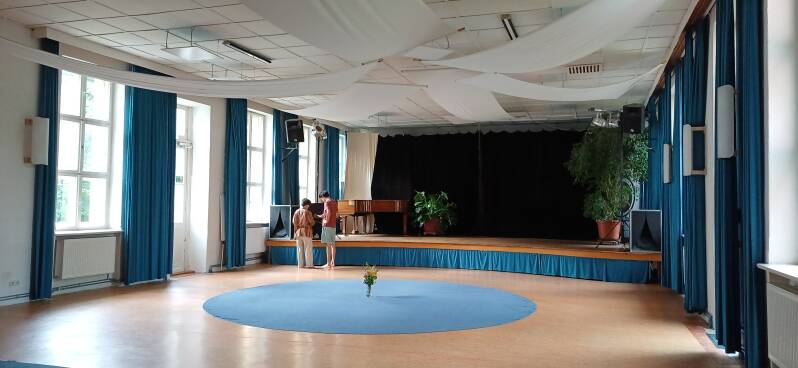
We visited the main seminar building, the Bildungszentrum, whose largest and most famous room with a theater stage is formally called the Aula (historically considered the building of the internal „university"). Here, in the afternoon, we had a talk with several members of ZEGG, ranging from the first inhabitants to a young woman studying elsewhere. Among other things, they explained that they are currently at a moment of generational handover and need young people to come and sustain this large structure, which requires a lot of work, since the vast majority of members are over 60 years old. For this reason, to ensure energetic continuity and barring any reasonable exception by mutual consent, the current community criterion dictates that new members must be under 50 years old. Decisions of this magnitude are managed horizontally through Sociocracy, using the principle of Consent, where a proposal is approved if no one presents a valid objection that harms the ecovillage's mission.
After this visit, it was also clear to me that being part of this community implies a rigorous commitment. The ZEGG center demonstrates that large-scale community life demands great shared responsibility to optimally sustain and self-manage its 15 hectares and 18,000 annual overnight stays without falling into burnout.
On a personal level, the visit highlights the need for discipline, maturity, and daily physical work to sustain an alternative project, completely overcoming any idyllic or romantic vision of community life.
At nightfall, we had a gathering at the bar with several people from the community and sing songs to the sound of Barbara's guitar. They have a very practical songbook system with printed sheets featuring a very large font size and a folder that allows them to be read from two different directions. We spend a cozy, pleasant time with the community, having a few beers and some soft drinks—all organic, of course.
I went to bed happy to have finally known this place from the inside and with the feeling of being in a location with a tremendous amount of lived history, where I would like to take almost all the courses they offer.
From this website: „Community and Learning Place
The combination of living community and educational centre makes ZEGG a special place. In the midst of our social and ecological model project, living and learning are interwoven.
Our educational programmes impart lived knowledge and offer experiential spaces that combine self-responsibility, touchability and open communication. In this way, we promote social change - towards more awareness, cooperation and sustainability. Our seminars focus on topics such as communication and social competence, art and ecology, love and relationships and community building.
ZEGG gGmbH is owned by ZEGG Trägerverein e.V. and run by the ZEGG community. For over 30 years, the ZEGG community has been developing a way of life based on love - among people, with nature and the greater whole. More than 100 people bring the education centre together and shape a sustainable living space. With ZEGG as a place to live and learn, they put cooperative and creative living into practice.
ZEGG was founded in 1991 as a "research and seminar place for a non-violent earth". 13 years of intensive community life in the "Bauhütte" were the preparation for this. In the social experiment led by Dieter Duhm, foundations were laid for a new culture. To develop this further, the community bought the ZEGG site in 1991 and moved there. Dieter Duhm and Sabine Lichtenfels and half of the ZEGG residents at the time created Tamera in Portugal in 1995. Over the years, important new influences, inspirations and residents came to ZEGG.
Vision & Mission
We humans live consciously, lovingly and freely as a responsible part of creation.
Our mission is deep social change towards a sustainable, holistic and sex-positive culture.
In community we explore personal and cultural conditions for trust, love and cooperation. This is the basis for our educational work. It offers protected and experimental spaces for living learning, transformational processes and consciousness development.
Our values
ZEGG is committed to a cultural change in society. This requires awareness and paradigm shifts in almost all areas of human life.
We are guided by seven guiding values:
1. Love
2. Spiritual Consciousness
3. Responsibility for the future of life
4. Community
5. Experimentation
6. Effectiveness
7. Wealth
Our seventh guiding value is the promotion of wealth for the benefit of all. Wealth is an expression of abundance and freedom and encompasses the material, the intellectual and the spiritual. We look back proudly and gratefully on decades of communal experience.
We have created an unusual, beautiful, ecological place and continue to develop it. We are rich in competence, deep consciousness and material resources. Through this wealth we can give effectively, receive further wealth in return and contribute to a more loving world.“
Adress:
ZEGG Education Center gGmbH
Rosa-Luxemburg-Straße 89
14806 Bad Belzig
+49 (0) 33841 595 100
Schloss Blumenthal / Germany
Immersion in Schloss Blumenthal: An Experience of Connection and the Economy for the Common Good
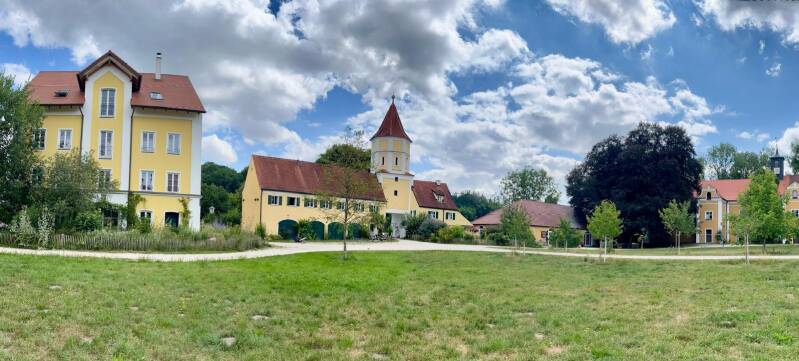
To orient ourselves geographically, we are located in the region of Bavaria, in southern Germany; specifically in the town of Aichach, an idyllic rural setting situated just over half an hour from the city of Augsburg and an hour from Munich.
Arriving at Schloss Blumenthal is like entering another dimension; you feel a harmonious blend of majestic history, living nature, and community work on a grand scale. As soon as we arrived, we jumped into action to help in the kitchen just as we had agreed: some of us went to harvest onions in the field while others stayed behind to prepare the food so that, shortly after, we could eat together in a communal dining room as majestic as the rest of the estate.
This entire agricultural infrastructure is sustained thanks to a Community-Supported Agriculture scheme—a system known as SoLaWi in Germany—where a 1.5-hectare organic garden directly supplies their restaurant, while 110 families from the region jointly finance the annual budget to receive weekly baskets of vegetables, collectively sharing both the abundance and the seasonal losses of the land.
In the afternoon, a member of the community guided us on a tour of the 35-hectare property. We were impressed to learn that the project was born at the end of 2006, when eight families pooled their savings to buy 50% of the historic site from the foundations of the famous Fugger family. Our guide confessed to us the immense amount of work invested: where the streets and the central square used to be nothing but gray cement, today you walk through a vast green park.
The tour began by crossing underneath the residential area, the permanent home of more than 40 adults and about 20 children who unanimously manage the project.
Connected to this environment, she explained that a Waldkindergarten operates in the property's forest—a nature kindergarten run as an independent association, where children are educated outdoors and actively collaborate in the garden.
Moving forward, she introduced us to the castle’s art and craft workshops. We also visited the bright seminar rooms, highly demanded sustainable spaces that represent the economic pillar of the place. Right after, the journey took an introspectively deep turn as she led us to their dark meditation cave (Dunkelraum), a corner of absolute sensory isolation. Moving towards the end of the tour in the central square, we passed by the farm shop (Hofladen)—stocked with their artisanal goat cheeses—to finish at the highest point of the complex.
Just before the end, she had an immense surprise in store for us... We climbed up a stone spiral staircase to the rooftop of the central building... wow!!!: a huge rooftop space designed for concerts. With that breathtaking beauty inside us, we went down to relax under the chestnut trees of their lively biergarten, where we had traditional German dishes for dinner.
At nightfall, we gathered with several members around a campfire to exchange impressions. We encountered a community that has renewed itself thanks to young families, most of whom work independent jobs as teachers, therapists, and coaches... The atmosphere became magical when, in the background, we heard a beautiful choir rehearsing, their voices floating over the castle rooftops, reminding us of the deep human connection that gives life to this eco-village.
They explained to us that joining the project requires a one-year selection process, involving workshops and a trial period of shared living. In line with this openness, they participate in the global WWOOFvolunteering network, but with a strict policy of only accepting volunteers for a minimum of one year; this is because the complexity of their cooperative ecosystem requires deep training. This entire social engine is organized under the principles of the Economy for the Common Good, prioritizing social well-being over traditional financial profit.
Our farewell came the next day, after an incredible buffet breakfast in the dining hall of their beautiful eco-hotel. It makes you want to stay! Incredible beautiful place and people! Amazing project, ecologic food, sustainable energy and social Economy!
Official Website (Native German): https://www.schloss-blumenthal.de
Hotel Information (In English): https://naturschlosshotel-blumenthal.com-bavaria.com/en/
Postal Address: Blumenthal 1, 86551 Aichach, Germany
Kommune Niederkaufungen / Germany
I’m really intrigued by this visit. I know it’s a very sophisticated and unique example of a sharing economy or communal economy—one that has been steadily developing for years.
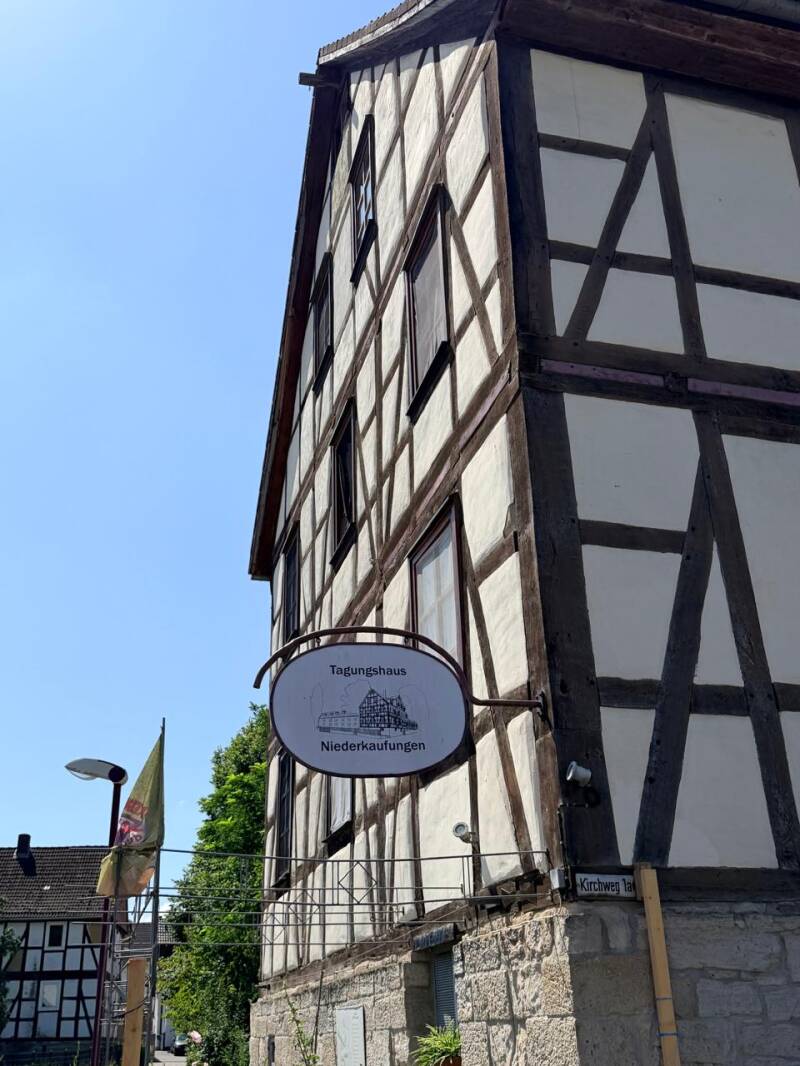
We arrived at a beautiful village. Its historic center stands out for its narrow streets and traditional half-timbered houses (Fachwerkhäuser), meticulously restored to preserve the rural German aesthetic that has remained intact for centuries. Stepping into this village and getting to know this commune has been like taking a journey through time and space; like stepping into a fairy tale. In fact, Niederkaufungen is directly linked to the Brothers Grimm and the Fairy Tale Trail (Märchenlandweg) due to its strategic geographic location at the historical epicenter where these famous stories were collected.
We’re greeted by a young woman who joined the commune two years ago, and she gives us a tour of the central complex—a building constructed on the site of an old barn and traditional farm buildings in the heart of the village. She tells us that there are currently about 80 people living there, comprising roughly 60 adults and about 20 children and young people. She explains that they’ve been operating for 40 years now, since 1986.
There are five communes in the Kassel area, and sometimes they share equipment and sometimes money. What they have in common is that they advocate for egalitarian decision-making and have shared workspaces. He tells us that this community was founded by many people from Hamburg who moved to Kassel because they could buy dilapidated buildings here at very low prices.
We enter through the ground floor of the main building, where they run a cozy café that also serves as the official venue for their weekly plenary assemblies. After getting to know this discussion space, we head up to the communal dining hall, stopping first at the financial bulletin board. This board is the cornerstone of their transparency: bank statements for the communal fund are openly posted there, allowing any member to review the income, donated assets, and collective expenses—which require unanimous consent if they exceed €200. Once on the upper floor, we enter the Great Dining Hall (Speiseraum), the social hub where they share daily meals prepared in their communal kitchen.
Stepping out into the outdoor courtyard, he shows us how they optimize resources as a community. We walk past another building in the complex where the communal laundry is centralized—a truly surprising space: they have only three large washing machines for the entire community! It’s managed through a very clever rotation and scheduling system that maximizes water efficiency and saves everyone time. Right there, he explains that they apply the same logic to transportation through their car-sharing system: they have just 6 cars for about 80 people. You coordinate using a whiteboard or an internal app, and you realize just how many private vehicles are sitting idle in our cities for no good reason.
The guide tells us that joining the commune is almost like getting married, because all your money goes into a common fund. This fund is divided into three categories: food, transportation, and housing. All these expenses are covered for each member. Most people work within the commune itself, but if they work outside it, they still contribute their income to the fund. There’s an elected group that acts as administrators, and there’s a relationship of complete trust with them, since the finances are entirely transparent. In addition, they have a cash fund from which, if you need to buy something for a one-time expense, you can take up to 200 euros directly.
It blows my mind; it’s self-managed communism. As we saw on the whiteboard, they keep track of what the money is spent on, and the group regulates itself because it’s in everyone’s interest to maintain a healthy economy. Another aspect that has fascinated me is that they have their own pension system: part of the money is invested in sustainable companies, and when you retire, you receive the returns on those investments.
After lunch, we’re served by a young man who has two children. He tells us that the commune has its own kindergarten and a care center for the elderly, which sometimes shares space with the younger children. It’s an intergenerational exchange that seems very enriching.
This young man, brimming with joy, shows us the extensive vegetable gardens that he manages himself along with two other people. He confides that he arrived here with 10,000 euros in debt and has now been 100% dedicated to managing this Sustainable Garden for three years—and he’s absolutely thrilled. They operate under the Solidarische Landwirtschaft (SoLawi) model, a solidarity-based and cooperative system of community-supported agriculture designed to manage organic plots of a certain size. It’s truly impressive to see. It’s really impressive to see their gardens and how well-maintained they are; everything is 100% organic.
In the afternoon, when we met with him for the Q&A session, we asked him what unites them socially beyond the strict economic structure. He told us that, in that regard, aside from the weekly meetings they hold and the fact that they obviously come together in common spaces or during their daily work routines, everyone lives their own life and they don’t have any significant social gatherings. That struck me. It seems like a pragmatic, anti-capitalist structure, but unlike other communities where there’s usually a very close-knit social fabric that constantly connects them, in this one—according to what he tells us—on a social level, everyone is quite independent.
I leave with a deep sense of hope upon seeing that there are possible middle paths between capitalism and state communism… The self-managed economy for the common good seems to work well. At least they’ve been proving it to themselves for 40 years. What an incredible example!
https://www.kommune-niederkaufungen.de/
Translated from this website into English:
„Due to high demand, a structured process has been developed that takes into account the various needs – both of the people living here and of those interested in joining the community.
Getting to know each other takes time. For many people, the community has been their home for years and even decades. It is not uncommon for one to two years to pass between first meeting and actually joining.
In any case, it is helpful to read our policy document and the current supplementary document, which describe life in the community and the original ideas behind its founding.
The Information Afternoon
For those who simply want to take a look at our project, the information afternoons, which take place several times a year, are the ideal format. As well as a guided tour, the basics of the commune are explained and there is an opportunity to ask questions.
The Commune Seminar
For anyone who wants to find out more, the commune seminar explains the fundamental aspects of the commune in detail over the course of a weekend. How are decisions made? How does the collective economy work? What does working in a collective mean? What are the challenges of everyday life in the commune? There is also plenty of time for participants’ questions.
The Interkomm Seminar
The Niederkaufungen Commune is one of a total of six communes in the Kassel area. These are linked together under the name ‘Interkomm’. Several times a year, there is the opportunity to take part in an Interkomm seminar. During these seminars, the common aspects of the communities – such as the shared economy or decision-making by consensus – are explained and discussed. Visits are also made to the various projects.
Introductory Weeks
Anyone interested in our community who wishes to find out more about whether a way of life such as that in the Niederkaufungen commune might offer prospects for their own life can live and work with us during an introductory week. The hosting of participants rotates between the shared accommodation groups. The host group decides independently whom to invite and how many participants will take part in the introductory week. A prerequisite for attending an introductory week is prior participation in a commune seminar or an inter-commune seminar.
… and joining
Supporters
Anyone who, after attending one or more introductory weeks, is specifically interested in joining the commune should submit a probationary period application in which they outline their intentions. By this stage, three mentors from the commune should have been identified who will support and guide the applicant. The entire group decides by consensus on the start of the probationary period.
Probationary Period & Joining the Community
The probationary period lasts 3 months. During this time, new members are already living in the community and are part of the collective day-to-day economy. At the end of these 3 months, a decision on whether they will join the community is made by consensus. After that, the person on probation may request further time to consider the matter and, if they wish, extend their probationary period.“
Adress:
Kommune Niederkaufungen e.V. Kirchweg 134260 Kaufungen
Tel.: 0049 - 5605-80070
eMail: info@kommune-niederkaufungen.de
Kommune Lebensbogen / Germany
A Regenerative Journey. The Pulse of Kommune Lebensbogen
I still remember the feeling upon crossing the boundaries of Kommune Lebensbogen (Projekt-Lebensbogen e.V.), located next to the imposing Habichtswald Nature Park. After leaving behind the intense dynamics of other communes in Germany, arriving there at dusk felt like a true breath of fresh air.
At the moment, with no large groups of visitors around, the space offered a difficult-to-explain calm. That first night, we stayed in extremely pleasant multi-room apartments, where the silence was only interrupted by the murmur of the forest. Sleeping there, surrounded by a deep peace emanating from every corner of nature, prepared me to truly connect with what it means to inhabit this place. The clean air and the warmth of an impromptu communal dinner welcomed me immediately, inviting introspection and grounding from the very first minute.
Beyond the scenic beauty, what truly marked my experience was discovering the heartbeat of a project where sustainability stops being a theory and becomes the daily pulse of 23 residents.
Unlike other communities where we saw a great deal of movement and had the opportunity to meet several of their members, the scene here was different: it seemed as though the others were on vacation, and the place felt surprisingly tranquil. We were only assisted by Carmen, a wonderful woman who immediately made us feel at home. As a heartwarming anecdote of that close coexistence, after finishing dinner she saw us all collaborating naturally: there, everyone pitches in to collect and clean dishes and cutlery, a small everyday gesture that perfectly reflects the spirit of cooperation of the place.
It is a low-rise yet large-scale facility used mostly as a youth hostel, and they are transforming it into a vibrant meeting point for the training of young activists. They organize everything from workshops on permaculture, respectful beekeeping, and alternative energy construction (Biomeiler), to cultural events, theater, and projects for children. Their seminar center and collective café are true engines of sustainable activism.
I was deeply surprised by their approach: they are part of the Academy for Potential Development and are clear that external social change is born first from internal development and the evolution of consciousness.
Common economy and Consensus minus. Here, the income from their initiatives is pooled into a common chest to sustain the entire community, and every decision—big or small—is taken strictly by consensus, listening and weaving agreements without majority impositions.
I leave with the firm impression that places like this are not isolated islands, but beacons of hope. Visiting it left me with the certainty that social change is built slowly, with hands in the earth, sharing resources and caring, above all else, for the common well-being and the heartbeat of the planet.
To join
To join Kommune Lebensbogen, you need to go through a phased integration process. The goal is to get to know the project and see if you adapt to their shared economy model and consensus-based decision-making.
The main stages are:
Introductory weekend: You attend an open-door weekend to get to know the land, learn about the community's political values, and ask initial questions.
Participation week: You live and work with them for a few days. You help out with gardening, kitchen duties, maintenance, or their conference center to experience daily life. [1]
Co-living phase (Mitleben): You stay there temporarily for a few weeks or months to deeply integrate into the routine and the group's communication dynamics.
Trial period: If the community agrees by consensus, you become an official candidate for about a year, participating in assemblies and their common economic system.
Final membership: After the trial year, the group decides on your permanent admission. To live there long-term, you formally join their cooperative.
If you prefer a shorter stay, you can sign up for their individual volunteering opportunities through the European Solidarity Corps Portal or fill out their official Lebensbogen Volunteer Survey to apply. (European Solidarity volunteering in Ecovillages and Ecoprojects: If you’re aged 18-30, and resident in the EU (or selected other countries such as Turkey), good news! The European Solidarity Corps, funded by the European Union, offers fully funded volunteering and traineeship opportunities, usually for 6 months to one year.
Your travel, accommodation and even pocket money is funded, so you don’t need to be out of pocket to travel abroad and discover community living. You’ll be assigned a mentor to help you get the best out of your experience, and there’s even free language training! Many of our member ecovillages and ecoprojects offer an opportunity to volunteer in their communities – explore them here! https://gen-europe.org/esc-volunteering-in-ecovillages/ )
More information about Lebenbogen :
https://lebensbogen.org/en/
Adress: Auf dem Dörbberg 13, 34289 Zierenberg, Germany
Erstelle deine eigene Website mit Webador